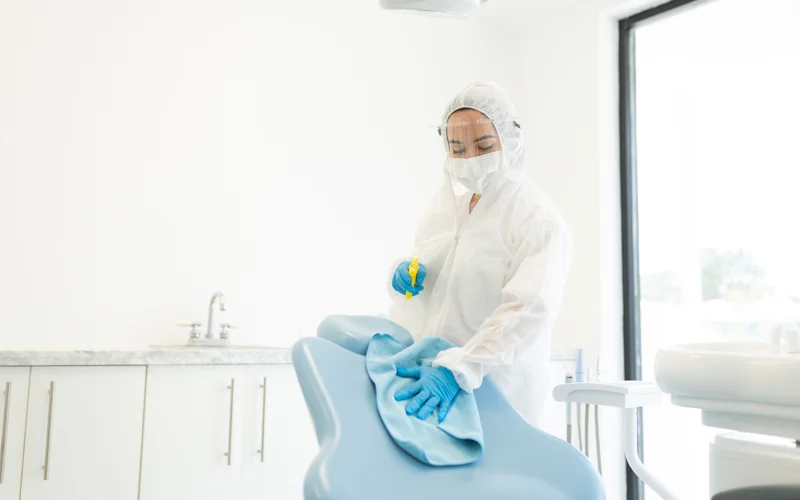
Dentistry has always been an evergreen industry. It grows in good economic times and bad, largely because the need for dental care is universal and durable. But 2020’s global pandemic did so much damage to the business some wondered if it would ever recover.
In the early months of COVID-19, pessimism seemed justified. Roughly 90% of dental practices were shut down in March 2020, with revenue taking a staggering 93% hit. It wasn’t until governments classified dental offices as essential that the hemorrhaging stopped. Even so, 2020 revenue remained far below 2019, and other negative impacts persisted for months:
- Patients were reluctant to keep their hygienist appointments for fear of catching the virus.
- They postponed elective procedures over safety concerns.
- Many dentists and office staff decided to leave their positions.
- Practices added expensive hard assets such as air-filtration systems to prevent COVID spread.
- Dental practices became heavy users of scarce (and more expensive) PPE, inflating overhead budgets.
By the end of the year, most dental offices were open, and patients came in for care, though at lower levels. Clearly, the industry sustained a body blow, but it survived. According to a Dental Economics/Levin Group survey, nearly three-quarters of all practices said they had lower collections in 2020 vs. 2019. Of those, 50% said their decrease was more than 10%, and 25% reported a more than 20% decline.
The survey found that 68% of practices had a 2020 profit decline. More than half experienced a decrease of more than 10%, and more than a quarter saw a 20% decrease. Compounding matters was the fact that 59% of dental practices saw their overhead expenses increase in 2020 compared with 2019.
As dentists closed their 2020 datebooks, it became clear the industry wouldn’t be down for long. As more governments reopened in spring 2021 and the percentage of Americans who received vaccinations grew, patients emerged from their “shelters” ready to schedule dental cleanings and other procedures. A recent American Dental Association/Health Policy Institute survey found that the industry gained back 86% of patient volume by May 17, 2021. Other studies found that fewer patients were canceling or not showing up for their appointments. They were now comfortable enough to schedule the elective procedures they postponed the prior spring.
The HPI survey wasn’t all sweetness and light, though. It found that dental practice owners were having trouble replacing the staff they lost during the crisis. Thirty-six percent were currently looking for dental assistants; 29 percent, dental hygienists; and 27%, administrative staff. Of the owner dentists who said they were looking for new staff, 80% said finding new hygienists and dental assistants was either extremely or very challenging. Since dental-practice employees were in short supply, it’s no wonder more than two-thirds of practice owners said they had to offer higher wages to persuade new employees to join their team.
Finally, the HPI survey painted a highly optimistic picture of the dental industry going forward. It found that dentists have been feeling more confident both in their own businesses and in the industry overall since earlier in 2021. The percentage of dentists who were very or somewhat confident that their practice would recover from 72% in January to 83% in May. Meanwhile, their confidence in the industry’s recovery went from 73% to 82%.
Further validating the industry’s future growth prospects was the level of mergers & acquisitions (M&A) activity over the last year. “By late summer 2020, the dental service organization (DSO) M&A markets were churning at a breakneck pace,” said Brian Colao, member and director, Dental Service Organizations Industry Group at Dykema. “There were more transactions closed in the final quarter of 2020 than I have ever seen during a single quarter in my 25 years in the dental industry,” Colao said in a Group Dentistry Now interview that 2020’s record-setting fourth quarter was driven by pent-up demand and by concerns over potential tax-code changes under the Biden Administration.
He added that M&A deals maintained their blistering pace in 2021, with worries of tax-code changes becoming more intense. “As a result,” Colao said, “2021 has all the makings of a record year for DSO M&A markets...The dental industry has truly proven itself to be virtually recession-proof and now pandemic-proof.”
The fact that dental practice financial results are approaching pre-COVID numbers, that new staff are being hired to replace those who left (though with some difficulty) and that dentists owners and corporate entities are continuing to do deals speaks to the fundamental strength of the dental industry. “Dentists, industry professionals and outsiders looking in had the opportunity to see the resilience of dentistry as an industry,” Mike White, CPA, CliftonLarsonAllen, told Group Dentistry Now.
Mitigating Your Pandemic Risks Going Forward
Just because America—and much of the world—appears to have turned the COVID-19 corner doesn’t mean dentists should loosen their infection-control measures. Not only should you continue to follow all regulatory protocols (CDC, OSHA, ADA and individual state governments and dental boards), you should also maintain strict universal precautions and other measures added last year to combat the virus. The emergence of the Delta variant means future COVID flare-ups are a real threat.
It’s also a good time to re-evaluate your malpractice insurance coverage to make sure it’s still adequately protecting you. For example, check your policy to see how it addresses the following features:
- Limits of liability: Based on everything that’s happened over the last year and a half, do you still have enough coverage? For example, if you bought a $1 million/$3 million policy, are you satisfied no single claim will exceed $1 million, and multiple claims won’t exceed $3 million? If so, you won’t need to update your policy. But if you’re not, now is the time to contact your agent or broker to increase your limits.
- Policy tails: Perhaps the pandemic has given you second thoughts about remaining in your current practice or in the profession itself. Before you make a final decision, make sure your malpractice insurance has an extended reporting provision, also known as a “tail.” Why is this important? Because if you purchased a claims-made policy, your insurance coverage will stop protecting you once you cancel it. But as a dentist, it’s possible a claim won’t emerge for months or even years after you leave your job. To fully protect yourself, you need the ability to file a claim after you cancel your policy. If your current policy lacks this feature, you can ask your agent or broker to add it for an additional premium.
- Consent to settle: Many malpractice insurance policies give insurers the right to settle a claim without going to trial. In many cases, settlement is the appropriate approach. But if you’re convinced you’re not guilty and believe a settlement would tarnish your reputation, you’ll want your policy to have a “content to settle” feature. This allows you to reject a settlement if you believe it’s unfair or harmful to your interests.
- Practice specialties: Have you added—or plan to add—one or more new specialties to your practice in the pandemic’s wake? If so, check to see that your policy provides the right coverage for your new services. Are you planning to make teledentistry a permanent part of your business? If so, make sure your policy provides coverage for it.
- Entity coverage: Are you planning to change your practice’s legal structure? If so, you’ll need to add your entity’s name to your insurance policy. A related issue is whether to give your legal structure its own malpractice coverage (known as “separate limits”) or whether you’d like your personal limits to apply to the entity (“shared limits”). Either way, consult with your legal advisor and insurance agent or broker to determine the best approach for your business.
- Exclusions: Many malpractice insurance policies exclude certain dental procedures or certain types of sedation. If you use these procedures or sedation techniques, your malpractice coverage will have gaping holes. If your current insurance lacks the flexibility to address your unique approach to dentistry, you may need to shop for another insurance company.
In conclusion, American dental practices will likely return to form by year-end 2021, if not earlier. But that doesn’t mean the industry will simply go back to business as usual. The changes it adopted to prevent viral spread, to manage constrained revenue and to bring in much-needed new business will likely persist for many years to come. But one thing won’t change: you and your team will always remember the challenges and rewards of providing dental care during a global pandemic.
Having dental malpractice insurance is an essential element of every dentist’s risk-management program. Learn more about the Dentist Malpractice Insurance Program from 360 Coverage Pros.

Share this page.