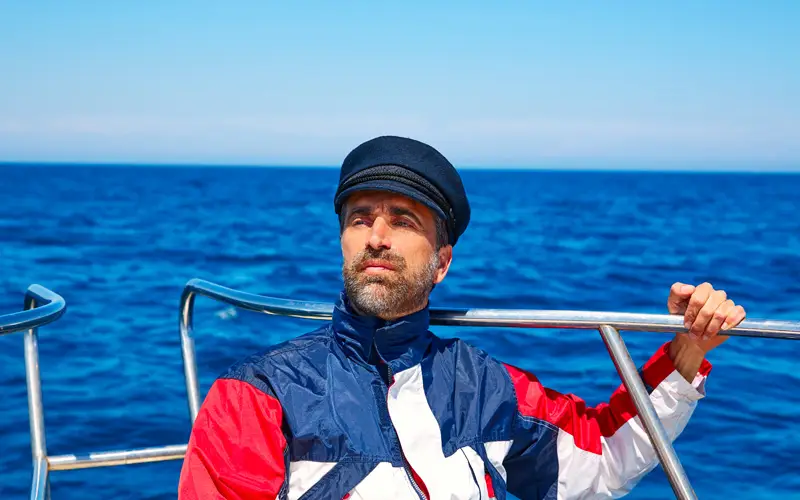
For most people, becoming a charter boat captain is a challenging but manageable process. The key is to know precisely what you need to do . . . and then do it.
Step 1: Decide on the type of OUPV Captain’s License to get. OUPV stands for “Operator of Uninspected Passenger Vessels.” It’s also referred to as the 6-pack license because it gives you the ability to transport six paying passengers and crew on charter trips. The OUPV/6-pack license comes in three versions. The Inland License lets you operate on bays, sounds, rivers, and lakes. The Great Lakes and Inland License allows you to work on the Great Lakes and inland waterways. Finally, the Near Coastal license grants you the right to ply inland and near-coastal waterways (extending to 100 miles offshore).
Step 2: Meet the Five United States Coast Guard (USCG) license prerequisites:
- Being at least 19 years old.
- Having at least 90 days of vessel experience within the last three years.
- Having 90 days experience on the ocean or near coastal waters (if not, the license will be limited to inland waters only).
- Having worked on an uninspected vessel with less than 100 gross tons.
Step 3: Pass a physical exam and a drug test. All OUPV license drug tests must screen for marijuana, cocaine, opiates, phencyclidine (PCP) and amphetamines. The testing procedures must comply with the requirements of 46 CFR Part 40. In addition, all drug testing laboratories must be Substance Abuse and Mental Health Services Administration (SAMHSA) approved. Other testing requirements include:
- Licensed Medical Review Officer (MRO) must examine test results.
- 5 Panel DOT drug test must be performed within a Federal Chain of Custody.
- The MRO must fill out and sign the CG-719P paperwork in ink.
- Specimens must not be reported as diluted.
Step 4: Get certified for adult CPR and basic first aid. These courses are available at local YMCAs, Red Cross affiliates and community colleges. You’ll need to submit proof of certification as part of your USCG license application.
Step 5: Get a TWIC card. This stands for Transportation Workers Identification Credential and refers to a background check completed by the U.S. Department of Homeland Security. You can apply for it online. As with CPR and first aid, you’ll supply proof in your license application.
Step 6: Prepare for your OUPV/6 Pack licensing test. You can either sit for USCG’s test or take one provided by a commercial captain’s school. In the latter case, the school will provide extensive learning materials and formal instruction to help you prepare. In the former case, you’ll find your own study guides and learn independently. Even though going through a school will cost hundreds of dollars, you will have a better chance of passing the test by completing a commercial course than by studying independently.
Step 7: Pay to take the test. If you opt to use an OUPV/6-Pack course at a commercial captain’s school, be prepared to spend a significant amount of money. For example, one well-known program costs $595. This includes access to training content in both digital and printed formats. The digital-only course is $495. There are numerous such courses available in the marketplace. Search the internet to determine which test preparation program best suits your needs and budget.
If you decide to prepare independently for the test, you’ll need to purchase testing directly from USCG. The options are complex. To determine your testing fee, refer to the USCG’s FAQ.
Step 8: Apply for Your 6-Pack License. Once you pass the test, it’s time to apply for your license. This, too, is a complex process. Here are the steps involved:
- Submit proof of having a Transportation Worker’s Identification Credential. Be sure to list your occupation as a Merchant Mariner. Make a photocopy of TWIC or a copy of the TWIC application receipt.
- Fill out a CG-719B Application for Merchant Mariner Credential.
- (IF APPLICABLE) Fill out a CG-719C Conviction Statement.
- Fill out a CG-719K Application for Medical Certificate or CG-719K/E Application for Medical Certificate for Entry Level Ratings.
- (OPTIONAL) 3rd Party Release: Can be listed on Page 5 of the CG-719B, Page 10 of the CG-719K, Page 5 of the CG-719K/E, and/or on an alternate form.
- Submit Drug Testing Results using the CG-719P Periodic Drug Testing Form or options listed on Page 2.
- Pay user fees at pay.gov (preferred payment method). Print a copy of your payment receipt to send with your application package.
- (IF APPLICABLE) Fill out CG-719S Sea Service or obtain other documented sea service.
- (IF APPLICABLE) Obtain relevant Training Course Certificate(s) and/or Assessment(s). Make photocopies of all course completion certificates and/or completed assessments.
Once the USCG receives your application items, it will evaluate them. If they meet their requirements, they will issue you your OUPV license. With this credential under your belt, you’ll be capable of serving as captain on a charter boat.
Why It’s Critical to Protect Your New Credential with Marine License Insurance
If you plan to use your new license commercially, it’s essential to protect it against accidents, injuries and other liability exposures that may cause problems during one of your trips. One of the best ways is to purchase marine license insurance from an insurance broker who understands the risks 6-pack captains face.
What should marine license insurance cover?
It should cover the costs associated with a USCG investigation. This includes attorney’s fees and other defense costs, along with imposed penalties and fines. With marine license insurance, you will not have to pay out of pocket if you’re involved in a covered incident. In addition to protecting your license and livelihood from USCG investigations, your insurance should also shield you from allegations arising from civil or criminal charges, including paying for any legal judgments against you.
If your license is suspended during a USCG investigation, you will also need an income safety net. Depending on the length of the inquiry, license suspensions can be financially debilitating. Marine license insurance provides a loss-of-income option while also supplying a daily subsistence allowance. This means you’ll still be able to pay your bills even if you can’t work.
Traditionally, marine license insurance has not been easy to find or purchase. Fortunately, there’s a new and contemporary option for this essential protection: 360 Coverage Pros
360 Coverage Pros is an online insurance platform that provides liability protection to a wide range of business professionals, including mariners. It features online shopping technology that simplifies the process of buying insurance. Berkley Offshore Underwriting Managers underwrite the coverage, an A.M Best "A+" rated (Superior) insurer. By combining a seamless application process with strong, stable insurance coverage, 360 Coverage Pros has reshaped how professional mariners, including 6-pack captains, will buy insurance from now on.
Are you concerned about your professional risks as a mariner? Then consider buying convenient, affordable license and liability protection from 360 Coverage Pros.


Share this page.