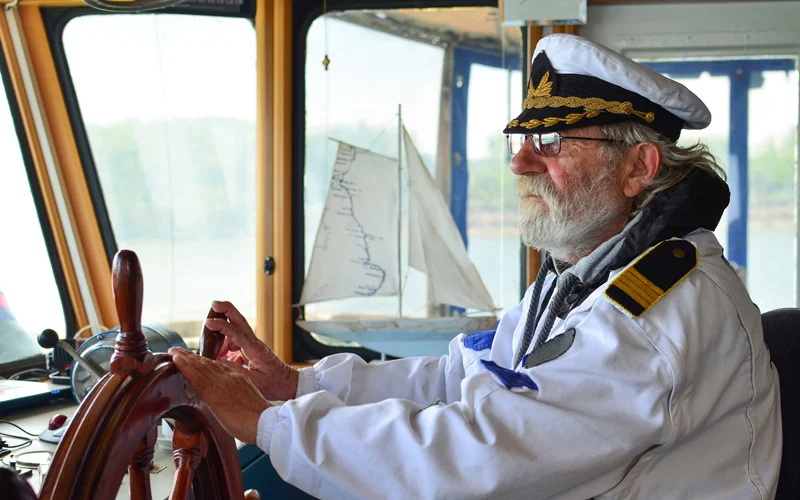
Operating mega-ships brings with it several potential risks. If you currently serve on one—or hope to—make sure to insure your license.
Any marine incident can have devastating consequences. But when the ship is a mega-vessel, the damages—physical, financial, and human—can go off the charts. The recent incident in the Suez Canal is a perfect case in point.
On March 23, 2021, the Japanese container ship, Ever Given, ran aground in the Suez waterway, through which 13% of global trade transits. The 200,000 ton, 1,312 ft. vessel deviated from its course and became wedged sideways in the canal, obstructing traffic for days. As one of the largest container ships in the world, carrying 20,124 TEUs of goods (a “Twenty-foot Equivalent Unit” equals one shipping container), an emergency refloating operation began. Eight tugs worked to free the ship, while diggers tried to remove sand from the sides of the canal where the ship was stuck.
Fortunately, on March 29, the effort succeeded, making an expensive salvage operation unnecessary. Offloading cargo from the largest ship to ever run ground in the Suez Canal could easily have taken weeks or months. Each day the canal was closed would have cost the world economy $9 billion in lost trade. The financial impact to the ship’s owner, Shoei Kisen KK, would likely have been extreme. As it is, the owner and its insurers will likely face millions of dollars in claims from the Suez Canal Authority (SCA), as well as from the owners of the more than 300 ships stuck in the canal’s blocked queue.
The Suez Canal isn’t the only trade route super-large ships imperil. The Panama Canal, the Singapore Strait and the Strait of Hormuz are all considered vulnerable to mega-vessel accidents.
The Rise of Jumbo Ships
The advent of tremendously large cargo ships, as well as giant cruise ships, has been decades in the making. Many years ago, ships transporting 3,000 containers were considered large. Today, jumbo ships commonly transport 20,000 or more containers. As the fastest-growing category of cargo vessels, mega-ship growth is expected to continue over the near- to medium-term. According to a United Nations report, between 2006 and 2020, the largest shipping vessels grew by 155% and are unloading 125% more cargo at each port visited.
Despite added risks, industry observers don’t expect a reduction in the number of mega-ships plying the world’s seas. Although they initially took off in response to the high oil prices of the 2000s, they also sought to improve the economics of shipping. The search for economies of scale continues today. Since large ships allow for the spreading of shipping costs across a larger base of cargo, the financial advantages to shippers are still considerable. Also, interest rates continue to sit at historically low levels, making it financially advantageous for shipyards to keep building mega vessels.
The advantages of super-large vessels are offset by the mounting risks they pose. As ships grow in size from “handysize” (vessels or product tankers with a deadweight up to 50,000 tons) to ultra-large crude carriers (giant supertankers up to 550,000 deadweight tonnage), they become increasingly risky for owners and the professional mariners who operate them.
Super-Sized Ships Bring Mega Risks
It’s not hard to see how larger ships expand risk. The larger they get, the more difficult it becomes to navigate. Larger ships are also more likely to produce severe accidents. For example, when a mega-vessel goes aground, the salvage process can be more complex and costly to handle. There is more cargo and fuel to offload and the environmental consequences can be more damaging than with smaller ships. Salvaging so much cargo under extreme time constraints and in remote and challenging environmental conditions is also more difficult and expensive. The regulatory aftermath of large-ship pollution spills can be equally damaging.
With giant ships, the risk of containers being miscategorized, leading to them being handled and stored unsafely, also increases. For example, in March of 2018, incorrectly declared chemical cargo sparked a fire on the 15,252 TEU Maersk Honam, which was traveling in the Arabian Sea near Oman. Despite the crew’s efforts to quell the blaze, it went out of control, forcing the crew to abandon the ship. By the time the incident ended, five crewmen were dead.
The Maersk Honam accident is far from an isolated event. In addition to the recent Ever Given Suez grounding, there have been at least four serious incidents involving large cargo vessels over the last two years. According to Falvey Cargo Updates, accidents occurred on the following ships:
- ONE Aquila: A container stack collapsed during a storm while the ship traveled from China to California. A heavy storm caused a stack of at least 100 containers to fall overboard.
- M/V ONE Apus: Another case of container stacks collapsing, leading to the damage or loss of 1,816 containers at a financial cost of $75 million to $150 million.
- Maersk Essen: In transit from China to Los Angeles, the vessel encountered a storm that resulted in the loss of 750 containers.
- Maersk Eindhoven: The vessel lost engine propulsion off the coast of Japan, causing 260 containers to roll overboard and damaging 65 others.
The above incidents not only had major financial implications, which were penalizing enough, they also likely affected the careers of the professional mariners involved. If authorities found they made a professional mistake (or failed to do something important), they may have faced the loss of their marine licenses, not to mention large fines and penalties.
Finally, mega-ship risks aren’t just about accidents on the open sea. They also relate to the inadequacy of waterways and ports to handle huge vessels. For example, the masters of large container and cruise ships need accurate information about the characteristics of the waterways they travel on. However, maritime navigational charts can be outdated, in part because nations have failed to invest in hydrographic surveys of national waters and bathymetric surveys of international waters. This leaves mega-ship masters in the position of not being able to fully trust their navigational charts. Without correct navigational data, operating super-sized ships can become an even riskier endeavor.
Operating a mega-ship brings unique challenges; not every marine officer is qualified to serve on them. This has led to a shortage of mariners with the required big-ship skill set. To the extent large vessels set sail without enough crew, they may set themselves up for more incidents and potentially large financial losses.
Mariner Liability Insurance for Professional Mariners
If you serve on a large vessel, you don’t need us to tell you what’s at stake. But if you haven’t covered yourself with comprehensive mariner liability insurance, you are living dangerously. Similarly, if you currently serve on a smaller vessel and have ambitions to move up to a mega-ship, then having insurance will help to preserve your license if you find yourself involved in current or future disciplinary proceedings or lawsuits. In either case, given the risks of operating large and small cargo ships and other types of vessels, protecting yourself with insurance will always be a sensible strategy.
How Does Mariner Liability Insurance Work?
Coverage responds abruptly at the onset of any incident. Upon United States Coast Guard (USCG) or other governmental authority’s investigations of an incident, policyholders are connected with an admiralty attorney who will speak directly with the regulatory authority on behalf of the insured. Coverage includes admiralty attorney’s fees and other associated defense costs, along with mandated penalties and fines. With mariner liability insurance, minus any deductible, you will not have to pay out of pocket if you’re involved in a covered incident. In addition to protecting your license and career from USCG and governmental authority investigations, your insurance will also protect you against civil or criminal allegations. This includes paying for any legal judgments a judge or jury imposes on you.
If your license is suspended during an investigation, your insurance will also generate an income safety net. Depending on the length of the inquiry, license suspensions can be financially ruinous. Mariner liability insurance also provides a loss-of-income add-on option while supplying a daily subsistence allowance.
Traditionally, mariner liability insurance have not been so easy to shop around for or buy. Fortunately, there’s a contemporary option for this important protection with 360 Coverage Pros.
360 Coverage Pros is an online insurance platform that provides professional liability protection to a wide range of business professionals, including USCG-licensed officers and crew. The website features a seamless application process that simplifies the entire buying experience. Coverage is underwritten by Berkley Offshore, an A.M Best “A+” (Superior) rated carrier. By combining best-in-class coverage and service with a simple application process, 360 Coverage Pros has reshaped how captains and crew, including masters of mega-ships, can purchase insurance.
Are you concerned about your professional risks as a mariner? Then consider buying convenient, affordable license and liability protection from 360 Coverage Pros.

Share this page.